How Does Invoice Finance Work?
The process is relatively simple.
- You complete the work. You provide the agreed goods or services to your customer.
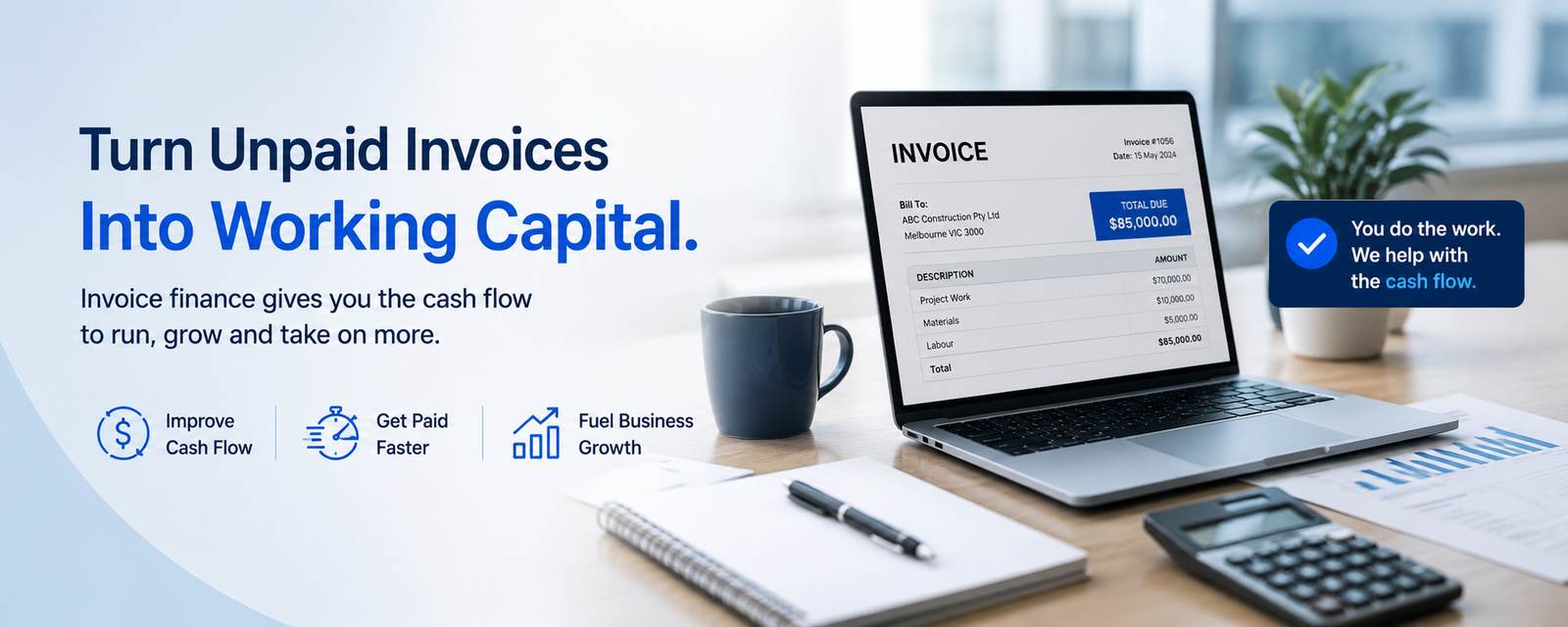
- You issue the invoice. For example: $100,000, payable in 60 days.
- The invoice is assessed. The provider reviews the invoice and the underlying customer relationship.
- Funding is made available. If the invoice meets the financier's criteria, an agreed percentage of its value may be advanced.
- Your customer pays according to the agreed arrangement.
- The facility is settled. The remaining amount is dealt with under the facility terms, after fees and charges.
The important point: you don't have to wait the full 60 days to access working capital from an eligible invoice.
Advance percentages, timing, fees and structure vary between financiers. Some Australian providers advertise advances around 80–90% of eligible invoices, but this should never be treated as a guaranteed amount.
Back to Sarah. She has $420,000 in outstanding invoices. Suppose — purely as an illustration — a financier approves an 80% advance rate against her eligible invoices. That could potentially provide around $336,000 of working capital.
Sarah hasn't made more sales. She hasn't forced her customers to pay early. She has simply accessed part of the value already sitting inside her receivables, sooner.
The figures above are illustrative only.
Why Can a Growing Business Run Short of Cash?
You might think that if sales are growing, cash flow should be getting easier.
Not necessarily.
Imagine Sarah wins another $300,000 contract. Good news. But to deliver it she has to buy materials, pay subcontractors, put more people on the job and cover transport — often before the customer pays 60 days later.
Growth itself creates a larger working-capital requirement.
The Australian Government describes cash flow as the movement of money into and out of a business, and recommends actively managing the timing of receipts and payments — noting that collecting customer payments faster frees up cash.
A full order book doesn't always mean a full bank account.
What Makes an Invoice Suitable?
Having unpaid invoices doesn't automatically mean every invoice can be financed.
A financier is generally looking for invoices that represent a genuine, completed transaction with a realistic prospect of payment. In practice, a strong application usually has:
- A genuine B2B transaction — goods or services actually supplied to a customer.
- A clear amount owing — what was supplied, how much is owed and when it's due.
- An established customer — their financial strength and payment history matter, because the invoice ultimately has to be paid.
- Reasonable payment terms — standard commercial terms are easier to assess than invoices already well overdue.
- No major dispute — a disputed amount may not be treated as readily available funding.
- Good supporting records — contracts, purchase orders, delivery records or timesheets that show the transaction is genuine.
- A clear debtor ledger — who owes you, how much, and when it's due.
So the better question isn't "How many invoices do I have?" It's "How strong is my debtor book?"
Why your customer matters
Invoice finance looks beyond your own bank balance. The quality of your customers matters too.
Say Sarah has two customers who each owe her $100,000. Customer A is a large business trading for 15 years that always pays on time. Customer B is newly established with a history of late payment.
Same amount owed. Different risk. Because the funding is ultimately connected to money those customers owe, a financier may look closely at your debtor ledger — not just your turnover.
What if a customer disputes an invoice?
Say Sarah sends a $150,000 invoice and the customer disputes $30,000 of it. The financier may not treat the full $150,000 as readily financeable — because there's genuine uncertainty over when, or whether, that portion will be collected.
This is why good invoicing matters. Clear contracts, accurate invoices and delivery records keep your receivables clean. The Australian Government similarly recommends sending correct invoices promptly and following up unpaid ones as part of good cash-flow management.
What Can You Use Invoice Finance For?
Invoice finance is generally used for working capital — for example:
- Paying suppliers when they want payment in 30 days but your customer pays in 60.
- Funding wages, because your employees don't wait for your customers to pay.
- Buying materials needed before you can complete and invoice the next job.
- Taking on a larger contract that creates a big working-capital gap before payment.
- Managing rapid growth, where more sales mean more money tied up in receivables.
- Smoothing seasonal cash flow between busy and quiet periods.
The key is to use the funding to support the business — not to paper over an underlying problem.
Sarah's $800,000 contract. Six months later, Sarah wins an $800,000 contract with 60-day payment terms. She calculates she'll need roughly $300,000 in working capital to deliver it before the customer pays.
Without funding, she might have to slow the project or lean on suppliers. With a strong debtor book and an appropriate facility, invoice finance can bridge the gap between doing the work and getting paid for it.
That's the shift worth noticing: invoice finance isn't only a safety net. It can be a growth tool. The problem often isn't a lack of business — it's the timing of the cash.
Invoice Finance Isn't Just for Businesses in Trouble
This is a misconception we hear often: "If I use invoice finance, my business must be struggling."
Not necessarily.
A business can be profitable, well managed and growing — and still have a working-capital gap. In fact, rapid growth usually makes that gap larger.
Invoice $100,000 a month on 30-day terms and you have one level of money tied up in receivables. Grow to $500,000 a month on the same terms and the amount sitting in unpaid invoices becomes much larger.
The business hasn't become weaker. The cash cycle has simply become bigger.
How Much Can You Access — and What Does It Cost?
How much
There's no single answer. The amount available depends on the value of your eligible invoices, the quality and payment history of your customers, your industry, your trading history, debtor concentration, payment terms, existing finance and the financier's criteria.
As an illustration only: $500,000 of eligible invoices at an 80% advance rate could point to around $400,000 of initial funding. That's an example, not a promise of what your business can access.
What it costs
Here's where owners need to look past the headline rate.
Invoice finance is typically priced as a fee on the invoice value for the period the funds are drawn, often alongside a facility or service fee — rather than a single interest rate you can compare like a term loan. Depending on the provider and structure, costs may include establishment fees, facility fees, funding charges, service or management fees, and transaction charges.
So don't only ask "What's the interest rate?" Ask "What will this facility cost my business in total?" — and then the more important question:
"What will this funding let my business achieve?"
If accessing $300,000 of working capital lets you deliver a contract that generates substantially more value, the economics may make sense. If you're using the facility to cover an ongoing loss, it may be masking a bigger problem. Finance should support a sound business model — not replace one.
All figures are illustrative only.
Will Your Customers Know You're Using It?
For many owners this is the deciding question, so it's worth raising early rather than burying it.
It depends on the facility. Some arrangements involve the financier in collecting payment directly from your customers (a disclosed facility). Others let you keep managing customer collections yourself (a confidential facility).
If customer confidentiality matters to you, ask exactly how collections are handled before choosing a provider.
Invoice Finance vs a Business Loan vs an Overdraft
These solve different problems.
- Business loan — a lump sum for a defined purpose, repaid over an agreed period. Useful for expansion, acquisitions, property, equipment or other longer-term needs.
- Invoice finance — funding linked to your unpaid receivables. Useful when the issue is "I've already earned the money, but my customer hasn't paid me yet."
- Overdraft — a credit limit attached to your bank account. Useful for general short-term gaps, but it isn't tied to your receivables, so it doesn't grow with your sales the way an invoice facility can.
The Australian Government distinguishes invoice finance from traditional loans and overdrafts, describing it specifically as funding against unpaid invoices to manage cash flow.
There's no "best" product in isolation. There's only the structure that fits the problem you're solving.
Should You Look at Invoice Finance? A Quick Self-Check
You may want to investigate it if several of these are true:
- You're profitable but constantly short of cash — the P&L looks good, the bank balance doesn't.
- Your customers pay slower than your suppliers, so you're funding the gap.
- Your outstanding invoices keep growing as sales rise.
- You're turning down work because you can't fund delivery.
- Your overdraft is always near its limit.
- You're using personal money to keep the business moving.
- You have a strong order book but uneven cash flow — a timing problem, not a sales problem.
When it may not be the right answer
Invoice finance isn't automatically the solution just because you have unpaid invoices. It may not suit you if most customers pay immediately, you have few B2B invoices, your invoices are regularly disputed, your customers pay poorly, your receivables are highly concentrated, or your margins are very low.
The clearest test: if the underlying problem is "we're losing money on every job," more working capital won't fix it. But if it's "we're profitable, but customers pay 60 days after we have to pay everyone else," that's exactly the problem invoice finance is built for.