

Buying a business is one of the fastest ways to become your own boss—but it’s also one of the biggest financial decisions you’ll ever make.
Unlike starting a business from scratch, buying an established business gives you existing customers, proven systems, trained staff, and immediate cash flow. However, it also comes with risks that many first-time buyers don’t discover until it’s too late.
One of the biggest surprises? The price you agree to pay isn’t always the amount a lender is willing to finance.
Many buyers spend weeks negotiating with a seller, pay a deposit, and emotionally commit to the purchase—only to discover that the bank values the business very differently.
That’s exactly why understanding business acquisition finance before making an offer is so important.
In this guide, you’ll learn:
How business acquisition finance works in Australia
How lenders assess a business purchase
Why banks often value businesses differently from buyers
How much deposit you may need
What due diligence really means
Common mistakes first-time buyers make
Practical ways to structure your purchase
Throughout this guide, we’ll also follow the story of David, a fictional business buyer based on the real situations we regularly see at Probiz Finance. His experience reflects many of the questions first-time buyers ask before purchasing their first business.
For many Australians, buying an existing business can be less risky than building one from the ground up.
Instead of spending years finding customers, building a reputation, and creating systems, you’re purchasing a business that’s already operating.
Some of the biggest advantages include:
A successful business already has customers and revenue, which means you can start generating income from day one instead of waiting months—or even years—to become profitable.
Building customer trust takes time. An existing business may already have loyal clients who return regularly, giving you a stronger foundation than a brand-new venture.
Many established businesses have documented procedures, experienced staff, supplier relationships, and operational systems already in place.
Lenders generally prefer businesses with an established trading history because they can assess historical financial performance rather than relying entirely on projections.
That doesn’t mean finance is guaranteed—but an established business usually provides lenders with more information to assess risk.
Buying a business may suit you if you:
If you’re purchasing your first business, arranging finance early can help you understand what’s realistically within your budget before negotiating with a seller.
Business acquisition finance is funding used to purchase an existing business.
Unlike a standard business loan used for working capital or expansion, business acquisition finance is specifically designed to help buyers purchase an established business.
Depending on the transaction, the finance may be secured against:
However, not every part of the purchase price is treated equally by lenders.
That’s one of the biggest misconceptions among first-time buyers
Imagine you’re buying a manufacturing business for $1.5 million.
The purchase price includes:
| Asset | Value |
|---|---|
| Equipment | $500,000 |
| Stock | $250,000 |
| Vehicles | $150,000 |
| Goodwill | $600,000 |
Although the agreed purchase price is $1.5 million, the lender doesn’t automatically lend against the full amount.
Why?
Because some assets can be sold if the borrower defaults.
Others can’t.
Understanding that difference is the foundation of business acquisition finance.
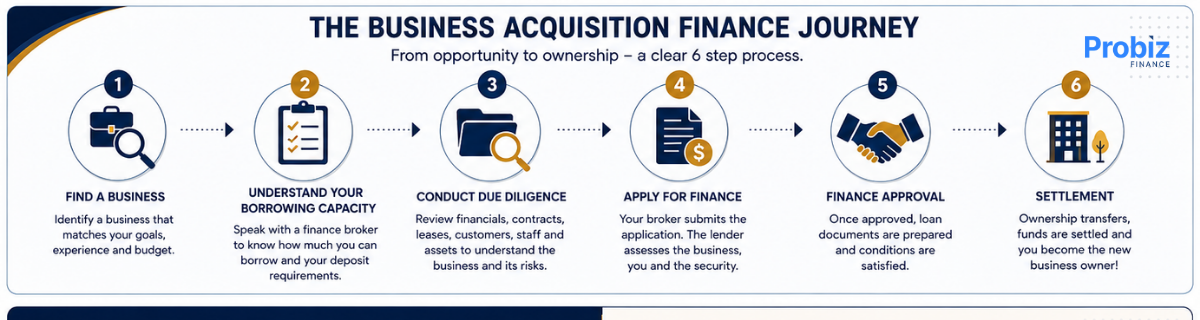
Although every transaction is different, most business purchases follow a similar process.
You identify a business that matches your goals, experience and budget.
Many buyers start with business brokers, industry contacts or online business marketplaces.
Before making an offer, speak with a finance broker.
This helps you understand:
how much you can borrow
your likely deposit requirement
what lenders may accept as security
whether the business is likely to be financeable
This is one of the most important steps—and one that’s often skipped.
Before committing to the purchase, investigate the business thoroughly.
This includes reviewing:
Due diligence isn’t about proving the business is good.
It’s about identifying risks before you become the owner.
Once due diligence is complete, your broker prepares the finance application and submits it to suitable lenders.
The lender then reviews:
Once finance is approved and legal documents are completed, settlement takes place.
Ownership transfers to you, and you officially become the new business owner.
To explain how business acquisition finance works in the real world, let’s follow David.
David isn’t one specific client.
He’s a fictional character based on the situations we regularly see when helping Australians buy businesses. His story combines many of the questions, challenges and mistakes that first-time buyers experience.
David is 44 years old.
After spending more than 20 years working as an operations manager in the logistics industry, he decides it’s time to build something of his own instead of someone else’s business.
Eventually, he finds what looks like the perfect opportunity.
An established parts distribution business in Melbourne’s northern suburbs.
The business has been operating for more than 25 years.
It has loyal customers.
Experienced staff.
Strong profits.
A retiring owner.
The asking price is $1.4 million.
David has savings.
He has equity in his home.
The numbers seem to work.
Excited by the opportunity, he negotiates with the seller, pays a deposit and shakes hands on the deal.
Only then does he begin arranging finance.
Unfortunately, this is where many buyers discover a problem they never expected.
Several weeks later, the lender completes its assessment.
David expects finance for the agreed purchase price.
Instead, the lender values the business at approximately $900,000.
The difference?
David’s immediate reaction is one we hear often.
“How can the business suddenly be worth half a million dollars less? The seller didn’t lie.”
The seller hadn’t done anything wrong.
The lender wasn’t saying the business was bad.
Both parties were simply measuring value in different ways.
This is one of the most misunderstood parts of buying a business.
As a buyer, you’re paying for future opportunity.
You’re buying:
future income
customer relationships
reputation
experienced staff
brand recognition
years of hard work invested by the current owner
A lender looks at the transaction very differently.
Instead of asking:
“Is this a great business?”
They’re asking:
“If the borrower stops repaying the loan, what assets can we recover and sell?”
That difference changes everything.
When buyers value a business, they often think about:
These things absolutely have value.
They’re often the reason someone is willing to pay a premium for a successful business.
Lenders must manage risk.
If something goes wrong, they need security that can potentially be sold to recover part of the outstanding loan.
That’s why they generally place greater value on tangible assets such as:
These assets have an identifiable resale value.
They can usually be independently valued.
They may also be easier to sell if required.
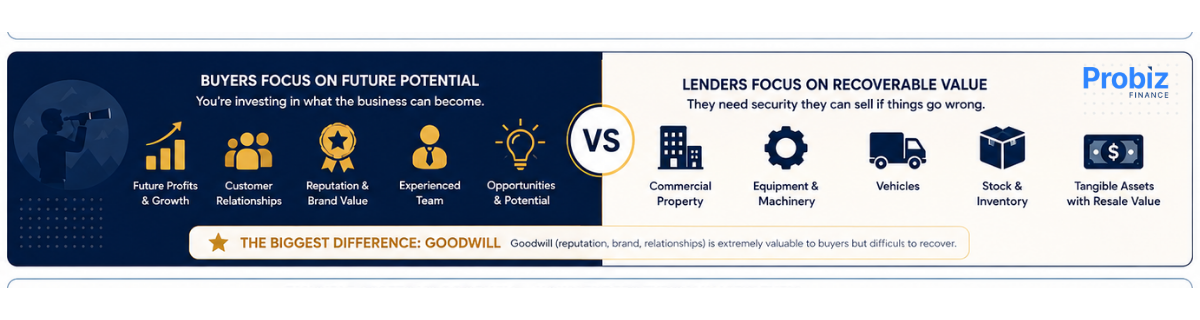
The largest gap between a buyer’s expectations and a lender’s assessment usually comes down to one word:
Goodwill.
Goodwill represents the intangible value of a business.
It includes things like:
reputation
brand recognition
customer loyalty
long-standing relationships
trading history
intellectual property
These things can make a business extremely valuable.
But they’re also much harder for a lender to recover if the business fails.
That’s why lenders often take a more conservative approach when assessing goodwill as security. This was the key issue highlighted in David’s story, where a significant portion of the purchase price reflected goodwill rather than tangible assets.
Buying a profitable business doesn’t automatically mean you’ll get finance.
Before approving a business acquisition loan, lenders assess whether the business—and the buyer—present an acceptable level of risk.
Their goal isn’t just to determine whether the business is successful today.
They also want confidence that the business can continue generating enough cash flow to repay the loan in the future.
While every lender has its own credit policy, most will assess the following areas.
This is usually the first question a lender asks.
A business may have impressive revenue, but revenue alone doesn’t repay loans.
What matters is whether the business generates consistent and sustainable profits.
Lenders typically review:
They’re looking for businesses with stable earnings rather than unpredictable income.
Quick Tip
A business that earns $2 million in revenue but only $40,000 in profit may be considered riskier than one generating $800,000 in revenue with strong, consistent profits.
Historical profits are important.
But lenders also ask another question:
Will these profits continue after the current owner leaves?
This is where many first-time buyers get caught out.
Some businesses perform exceptionally well because of the owner’s personal relationships, reputation or specialist knowledge.
If those relationships disappear after settlement, profits may decline.
That’s why lenders look beyond historical financials and assess whether the business can continue performing under new ownership.
David assumed he was buying a business that generated reliable profits. On paper, the numbers looked strong.
But after reviewing the business more closely, another issue became obvious.
More than half of the company’s revenue came from just three customers.
Even more concerning, two of those relationships existed because of the retiring owner’s personal friendships.
The obvious question became:
Would those customers stay after the owner retired?
Nobody could guarantee they would and that increased the lender’s risk considerably.
One of the biggest differences between buying a business and buying property is the type of security available.
When financing a property purchase, the lender has real estate as security.
Business purchases are often more complicated.
Lenders generally prefer assets that have a clear resale value.
These include:
These assets can usually be independently valued and, if necessary, sold.
The stronger the asset base, the stronger the security.
This is one of the biggest factors affecting business acquisition finance.
Many buyers assume the lender finances the agreed purchase price.
That’s rarely how it works.
Instead, lenders assess what proportion of the purchase price relates to tangible assets and what proportion represents goodwill.
Goodwill is the value that cannot be physically touched. It may include:
Brand reputation
Loyal customers
Trading history
Business name
Customer relationships
Intellectual property
Established systems
These things absolutely have value.
In fact, they’re often why buyers are willing to pay more for an established business.
However, goodwill is difficult for lenders to recover if the borrower defaults.
That’s why businesses with a high goodwill component often require buyers to contribute a larger deposit.
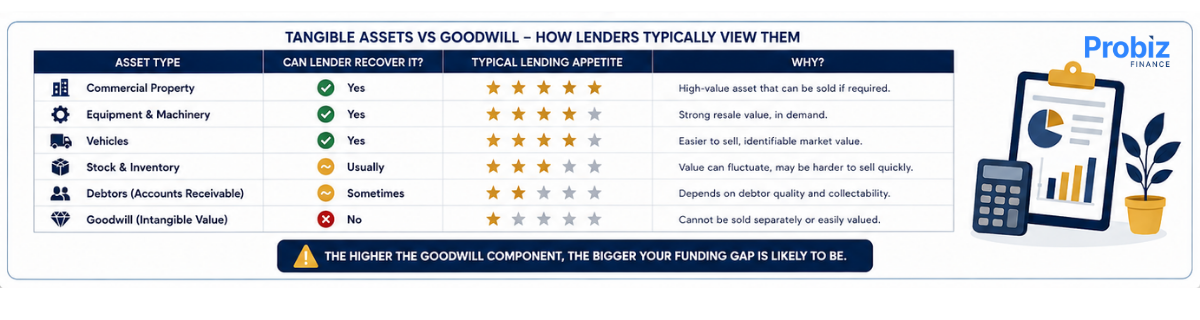
| What You’re Buying | Can a Lender Recover It? | Typical Lending Appetite |
|---|
| Commercial Property | ✅ Yes | Very High |
| Assets & Machinery | ✅ Yes | High |
| Vehicles | ✅ Yes | High |
| Stock & Inventory | ✅ Usually | Moderate |
| Debtors | Sometimes | Moderate |
| Goodwill | ❌ No | Limited |
The higher the goodwill component, the larger your funding gap is likely to be.
Imagine buying a business where:
one customer generates 60% of sales
that customer leaves after settlement
Suddenly, the business may no longer generate enough income to repay the loan.
This is called customer concentration risk.
Most lenders prefer businesses with a diversified customer base rather than relying heavily on a few key clients.
As a buyer, this is something you should investigate before making an offer—not after.
Some businesses are genuine assets. Others are simply jobs with a business name.
The difference often comes down to owner dependency.
Ask yourself:
If the current owner disappeared tomorrow, would the business still operate successfully?
If the answer is no, you’re not just buying a business. You’re buying the owner’s daily involvement. That increases risk for both you and the lender.
David’s story highlighted this exact concern—whether the business would continue performing once the seller stepped away.
Lenders also review several operational and legal factors that buyers sometimes overlook.
These include:
A profitable business can still become difficult to finance if significant hidden liabilities exist.
One of the first questions buyers ask is:
“How much money do I actually need?”
Unfortunately, there isn’t a single answer.
The required deposit depends on:
However, the following ranges provide a useful guide.
| Business Type | Typical Buyer Contribution* |
|---|---|
| Business including commercial property | 20–30% |
| Asset-heavy businesses | 30–40% |
| Goodwill-heavy businesses | 50% or more |
| Some established franchises | Around 30% |
*Indicative only. Actual requirements vary between lenders and individual transactions.
The answer comes back to security.
If most of the purchase price consists of commercial property or equipment, lenders have stronger security.
If most of the value comes from goodwill, the lender’s risk increases.
As a result, buyers are often required to contribute more of their own funds.
Imagine two businesses are both selling for $2 million.
Commercial property included
Modern equipment
Strong asset base
A lender may finance a much larger percentage of the purchase price.
Consulting business
No property
Minimal equipment
Most value in goodwill
Even though the purchase price is the same, the buyer may need a significantly larger deposit because there are fewer tangible assets available as security.
Many buyers think due diligence is simply reviewing financial statements. It isn’t.
Good due diligence helps you understand what you’re actually buying and identify issues before they become expensive problems.
Use the following checklist as a starting point.
✔ Profit and Loss Statements
✔ Tax Returns
✔ BAS Statements
✔ Cash Flow
✔ Outstanding Loans
✔ Working Capital Requirements
✔ Owner’s Salary Adjustments
✔ One-off Expenses
One important lesson from David’s story is that business profits often need to be normalised.
For example, if the owner has been running personal expenses through the business—or hasn’t included the cost of replacing themselves in the business—those adjustments can significantly change the true profitability.
✔ Customer concentration
✔ Long-term contracts
✔ Contract transferability
✔ Customer retention
✔ Repeat business
Ask yourself:
Will these customers still be here after settlement?
✔ Supplier agreements
✔ Equipment condition
✔ Inventory
✔ Staff experience
✔ Key employee dependence
✔ Operational systems
✔ Lease
✔ Licences
✔ Permits
✔ Intellectual Property
✔ Existing legal disputes
✔ Employment obligations
Review:
GST obligations
PAYG
Payroll tax
Superannuation obligations
Outstanding ATO debt
Unexpected tax liabilities can become your problem after settlement if they aren’t identified early.
One of the biggest misconceptions among business buyers is that banks don’t finance goodwill at all. That’s not entirely true. The reality is more nuanced.
Yes, goodwill can be financed—but usually not on its own and rarely at 100% of its value.
Most lenders are prepared to lend against a portion of goodwill when the business has:
However, because goodwill cannot usually be repossessed or sold separately, lenders generally take a more conservative approach than they do with tangible assets.
Imagine two businesses.
Warehouse
Machinery
Vehicles
Stock
If the borrower defaults, these assets may have resale value.
Brand reputation
Loyal customers
Long-standing relationships
Established goodwill
These are valuable to a buyer.
But they’re much harder for a lender to recover if things go wrong. That’s why businesses with a large goodwill component often require buyers to contribute more equity or consider alternative funding structures.
This is where many buyers think the deal is over. In reality, it’s often just the beginning of the negotiation. A funding gap doesn’t necessarily mean the business can’t be purchased. It usually means the purchase needs to be structured differently.
Let’s look at the most common options.
One of the most effective ways to bridge a funding gap is vendor finance.
Vendor finance is an arrangement where the seller agrees to leave part of the purchase price in the business as a loan. Instead of receiving the full amount at settlement, the seller is repaid over an agreed period.
Example
Purchase Price: $1.5 million
Bank Finance: $1.0 million
Buyer’s Deposit: $300,000
Vendor Finance: $200,000
The buyer can proceed with the purchase, while the seller continues receiving repayments over time.
For buyers:
Reduces upfront cash required
Helps bridge funding gaps
Makes some transactions possible that otherwise wouldn’t proceed
For sellers:
Can increase the pool of potential buyers
Demonstrates confidence in the business
Encourages a smoother transition after settlement
As highlighted in David’s story, a seller who remains financially invested during the handover often has a strong incentive to help ensure customer relationships transfer successfully.
Another common solution is an earn-out.
An earn-out links part of the purchase price to the future performance of the business. Instead of paying the full amount upfront, the buyer agrees to pay additional amounts only if agreed targets are achieved after settlement.
Example
Purchase Price: $2 million
Pay at Settlement: $1.7 million
Additional $300,000 Payable only if revenue targets are achieved over the next two years.
This reduces risk for the buyer while rewarding the seller if the business performs as expected. As your original article explains, this approach can be particularly useful where customer relationships or future earnings are uncertain.
Many Australian business buyers use equity in their home to fund part of the purchase.
This can:
reduce the required cash contribution
improve borrowing capacity
make larger acquisitions possible
However, it’s important to understand the trade-off.
You’re effectively using your home as security for a business investment. That isn’t necessarily a bad decision. But it should always be a considered decision made after understanding the risks and discussing suitable finance structures.
Sometimes the best solution isn’t one loan. It’s multiple loans.
For example:
Commercial Property Loan
Equipment Finance
Business Acquisition Loan
Working Capital Facility
Because each facility is secured differently, separating them may produce a stronger overall finance structure than combining everything into one loan.
Buying a business is exciting. But excitement can sometimes lead to expensive decisions.
Here are some of the most common mistakes we see.
Many buyers:
Find business first.
Negotiate second.
Arrange finance last.
Unfortunately, that’s exactly backwards.
Understanding your borrowing capacity first gives you confidence during negotiations and helps you avoid committing to businesses that may not be financeable.
This was one of the central lessons from David’s experience.
Large revenue numbers don’t necessarily mean a healthy business.
Always understand:
If one or two customers generate most of the income, losing them could dramatically change the value of the business.
Always ask:
“What happens if the largest customer leaves?”
Many buyers assume goodwill can be financed just like equipment or property. It usually can’t. Understanding this early helps avoid funding surprises later.
Buying a business often involves:
finance brokers
accountants
solicitors
business valuers
Each professional sees different risks. Working together usually leads to better decisions.
Every transaction is different, but a typical business purchase follows a similar journey.
Week 1: Understand borrowing capacity and finance options
Week 2: Search for suitable businesses
Week 3: Make a conditional offer
Week 4–6: Conduct due diligence
Week 6–8: Lodge finance application
Week 8–10: Finance approval and legal documentation and Settlement Ownership transfers
Starting the finance conversation early can reduce delays later in the process.
Before signing a contract or paying a deposit, ask yourself:
How much of the purchase price is goodwill?
How much deposit will I need?
Is the business profitable after adjusting for owner expenses?
How dependent is the business on the current owner?
What percentage of revenue comes from the largest customers?
Will customer contracts transfer?
Does the lease provide long-term security?
Are there any hidden employee liabilities?
What funding options are available if the lender won’t finance the full purchase price?
Have I spoken with a finance broker before making my offer?
Answering these questions early can help you negotiate from a stronger position and avoid unexpected surprises later.
The required deposit depends on the type of business, available security, industry and lender requirements. Businesses with commercial property often require a lower buyer contribution than goodwill-heavy service businesses because property provides stronger security for the lender.
Yes.
Many first-time buyers successfully obtain business acquisition finance, particularly when they have relevant industry or management experience, a realistic deposit and a business with sustainable cash flow.
Most lenders expect buyers to contribute some equity.
However, structures such as vendor finance, home equity or staged acquisitions may help reduce the amount of cash required, depending on the circumstances. The original article notes these as common ways to bridge funding gaps.
Approval times vary depending on the lender and the complexity of the transaction.
Applications supported by complete financial information and thorough due diligence generally progress more smoothly than those with missing documentation.
In many cases, yes.
Understanding your borrowing capacity before negotiating with a seller can help you make realistic offers and avoid committing to businesses that may not be financeable. This is the key recommendation emphasised in David’s story.
Yes.
Vendor finance is commonly used when the lender’s assessment falls short of the agreed purchase price. It can reduce the buyer’s upfront funding requirement while keeping the seller financially invested during the transition.
Buying a business isn’t just about finding the right opportunity.
It’s about structuring the purchase in a way that’s financially sustainable.
The strongest buyers aren’t necessarily those with the biggest deposit.
They’re the ones who understand how lenders assess businesses, conduct thorough due diligence and arrange their finance before making commitments.
David’s story illustrates an important lesson.
His deal almost fell apart—not because the business was bad, but because the finance conversation happened too late.
Once the funding structure was revised and the purchase price reflected the risks identified during due diligence, the acquisition moved forward on much stronger terms.
Whether you’re buying your first business or adding another acquisition to your portfolio, taking the time to understand your finance options before signing a contract can save money, reduce stress and improve your negotiating position.
At Probiz Finance, we help Australian business buyers understand what lenders are likely to support before they make an offer.
Whether you’re purchasing a manufacturing business, transport company, retail business, medical practice or professional services firm, we can help you:
Understand your borrowing capacity
Estimate your deposit requirements
Compare suitable lenders
Structure your finance effectively
Navigate the approval process from application through to settlement
If you’re considering buying a business, speak with our team before signing a contract. The right finance strategy at the beginning of the journey can make all the difference.
YOUR BUSINESS, OUR PRIORITY
Help us improve. Our team will personally reach out to make things right.